
DURAGRAFT VASCULAR CONDUIT SOLUTION
Protecting the graft in the window that decides its future.
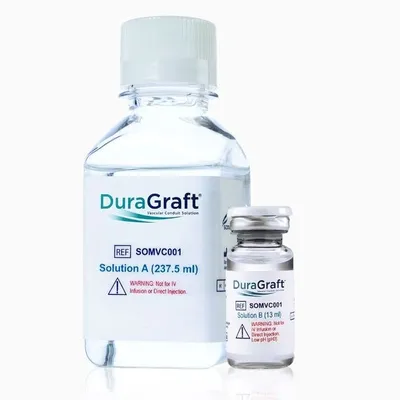
The first and only FDA De Novo granted solution for the flushing and storage of saphenous vein grafts during coronary artery bypass grafting (CABG) surgery.


10,000+
Procedures Performed Globally
THE UNMET NEED
A critical step without a standard.
There is no standard of care for that window. Heparinized saline and autologous blood are commonly used, but neither is FDA-indicated, quality-controlled, or specifically formulated for vein graft flushing and storage during CABG.
It is the one step in the procedure that has never had a purpose-built solution.
200K+
CABG procedures performed annually in the US
25.2%
Vein graft failure rate at 12–18 months
Injury begins the moment blood flow stops.
The intraoperative window, stage by stage.
1
Harvest
The structural integrity of the vein remains intact until the point of harvest, after which storage conditions initiate damage.
2
Ischemia & Endothelial Damage
The lack of blood flow during intraoperative vein storage in non-physiological solutions (saline) triggers acute ischemic injury, endothelial cell damage, and elevated oxidative stress. This is the main cause of early graft thrombosis and late graft disease.
3
Protection
DuraGraft is used to flush and store the graft at room temperature for up to 4 hours, maintaining graft cell viability and structural integrity through the intraoperative window.
The first device classification of its kind.
The FDA granted DuraGraft De Novo classification (Class II). This classification is reserved for devices with no prior market equivalent.
For the Surgeon
How DuraGraft Maintains Graft Cell Viability and Structural Integrity. Composition and Mechanism of Action.
For the Clinical Reviewer
Randomized trial data, a 2,964-patient registry, and the FDA De Novo review record.
For the Value Analysis Committee
Regulatory status, safety profile, and what adoption looks like in your OR.